
VR Workshop at SMS International School: When Students Travelled Beyond the Classroom
What if a classroom could take you around the world?
What if, instead of only reading about a historical monument in a textbook, you could feel as though you were standing there? What if you could travel from a school classroom to the ancient mountains of Machu Picchu and then to the icy landscapes of Antarctica—all in a single day?
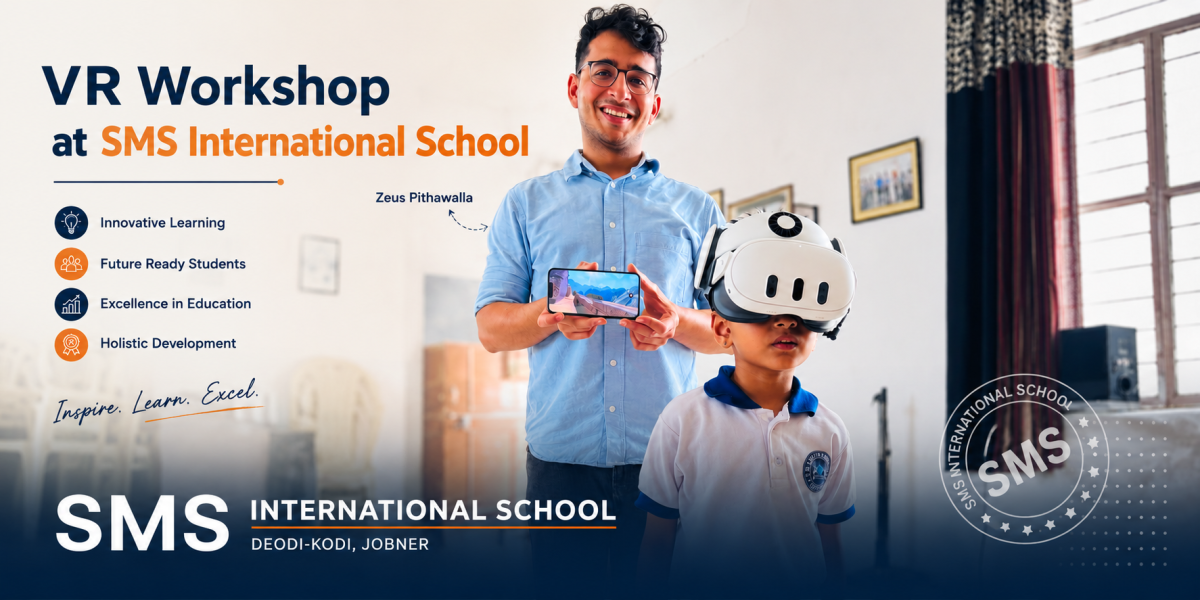
This is exactly the kind of exciting experience that students and teachers enjoyed during a special VR Workshop at SMS International School.
The workshop was conducted by Zeus Pithawalla, a Lecturer and PhD Candidate at Nottingham Trent University (NTU), England, UK, whose work brings together architecture, cultural heritage and digital technology.
Meet Zeus Pithawalla: Where Heritage Meets Technology
For students, meeting someone like Zeus Pithawalla was an interesting part of the experience. His work is connected to something many young learners are naturally curious about, how technology can change the way we experience the world.
Zeus’s research explores how Virtual Reality and serious games can help people engage with cultural heritage sites in new and exciting ways. His PhD research focuses on co-designing Virtual Reality serious games using Jaigarh Fort in India as a case study.
In simple words, his work explores an important question:
Can technology make history feel more real, interactive and exciting?
For students, this idea is particularly inspiring. It shows them that learning about history, architecture and culture does not always have to be limited to reading pages in a book. Technology can help them explore the past in completely new ways.
A Journey to Machu Picchu and Antarctica
During the workshop, students wore VR headsets and stepped into a completely different world.
One moment, they were in the school. The next, they were exploring Machu Picchu, one of the most fascinating archaeological sites in the world and recognised as one of the New Seven Wonders of the World.
Students also experienced the incredible landscapes of Antarctica, a place known for its vast ice-covered environment and extreme conditions.
The experience created excitement and curiosity among the students. It was not just about watching something on a screen—it was about feeling immersed in the experience.
Both students and teachers thoroughly enjoyed the VR session, making it a memorable and engaging day at SMS International School.
Why Experiences Like This Matter
A workshop like this gives students an important message: learning can happen in many different ways.
A student who may find a textbook chapter difficult to imagine may understand the same subject better after seeing a place through an immersive experience. A historical monument can become more meaningful when students can explore it virtually.
VR can encourage students to ask questions such as:
- What does this place look like in real life?
- Who built it and why?
- What can technology teach us about the past?
- Can we use technology to preserve historical places?
- What other places around the world can we explore through VR?
These questions can inspire curiosity, creativity and a desire to learn more.
More Than Just a Fun Experience
The VR workshop was not only exciting—it also gave students a glimpse into how technology can be connected with education, history and cultural heritage.
Zeus Pithawalla’s research itself reflects this connection. His work focuses on creating immersive and learner-centred experiences that can help people engage more meaningfully with cultural heritage.
His research on Virtual Reality Serious Games also highlights how digital experiences can be designed to make heritage more interactive and engaging for younger generations.
For students, this was also an opportunity to see how different subjects can come together. Technology, architecture, history, culture and creativity do not always have to be studied separately. In the real world, they can combine to create new ideas and new possibilities.
An Inspiring Message for Students
One of the most important lessons for students from this workshop was that there are no limits to what they can explore and learn.
A student who enjoys technology today may one day design educational VR experiences. A student interested in history may find new ways to preserve cultural heritage. Someone who loves gaming may create games that also teach and inspire others.
The future will need people who can connect different fields and think creatively.
The journey of researchers and educators like Zeus Pithawalla shows students that curiosity can lead to unexpected and exciting careers. It is possible to combine interests such as technology, architecture, gaming, history and cultural heritage and create something meaningful.
Leadership That Encourages New Ways of Learning
The workshop was supported by the leadership of SMS International School.
Chairman Dr. Rajendra Singh Khangarot addressed the students and encouraged them to embrace new technologies and innovative approaches to learning.
Principal Ms. Runa Sayeed coordinated and arranged the workshop, creating an opportunity for students to experience a new dimension of learning beyond the traditional classroom.
Director Mrs. Sakuntala Kanwar attended the session and motivated the students to participate actively and make the most of this unique educational experience.
Their presence and encouragement made the workshop even more meaningful for the students.
Learning Beyond the Classroom
The VR Workshop at SMS International School was a reminder that education is changing.
Today, students have access to technologies that can take them far beyond the walls of a classroom. They can explore distant places, understand historical sites and experience new environments through immersive technology.
For many students, the workshop was an exciting adventure.
But more importantly, it was an introduction to a future where learning can be interactive, immersive, creative and full of possibilities.
From the ancient world of Machu Picchu to the frozen landscapes of Antarctica, the students of SMS International School travelled far beyond their classroom—without ever leaving the school.
And perhaps, for some of them, this experience may be the beginning of a new dream, a new question or even a future career.